Tuesday, January 15, 2013
Multisensory Engagement, Part II - from Across the Country
Back in November, I published a blog post about multisensory engagement in sustainability and climate action, using examples from the Chicago Community Climate Action Toolkit. At the end of that post, I promised a follow-up post with examples from across the country. Here it is!
Here are some of my favorite examples of projects that attempt--successfully or unsuccessfully, you decide--to engage a broader audience in complex sustainability issues by drawing on the senses in very creative ways:
American Museum of Natural History: Our Global Kitchen Exhibit
This new exhibit explores connections between food, nature, and culture, using sight, smell, and taste. Sounds so creative--I hope to go visit next time I'm in New York!
Digital Media/Sound Artist Andrea Polli
Talk about creative: Andrea Polli uses all sorts of media, my favorite being sound, to help people think about the natural environment and climate change in new ways. Check out this blog entry about her from grist.org. Make sure to click on some of the links to other sites to hear and see her work,
DJ Spooky
More climate "sonification," this time from a DJ and graphic designer...
Sending A Message Through Song
Cincinnatti high school student Camille Jones wrote this wonderful blog post about the ability of song to facilitate change. Great links to some great songs included!
Symphony of Science
Another example of using song--this time to convey science directly.
Dance: The Seldoms
This Chicago dance troupe explores a number of social issues--including climate change. Here's a review of their performance in 2012, Exit Disclaimer: Science and Fiction Ahead. Wish I had seen it! Dance seems like an interesting medium through which to explore the importance of relationships and connection as a key strategy for survival.
Please share!
What's your favorite example here?
What other examples can you share with us?
Signing off,
Jenny

Thursday, January 3, 2013
Cities, Nature--and Meaning: Some Preliminary Musings
Three months ago, I attended the Healing Nature symposium at the Chicago Botanic Garden, sponsored by the Center for Humans and Nature, which explored the relationship between nature, personal, and community health. I was particularly inspired by a talk given by renowned scholar Stephen Kellert of the Yale University School of Forestry and Environmental Studies. Dr. Kellert is known for his work on biophilic design--integrating nature into the built environment (view the trailer for his film, Biophilic Design: The Architecture of Life). But what captivated me about his talk in October was his insistence that we need to develop place-based models for green building that both integrate nature and have cultural meaning, so that people feel connected to them.
To be clear, this is different from, though related to, efforts to look at design on a community-, rather than building-, scale, such as the standards released a few years ago by the US Green Building Council for LEED ND (Neighborhood Development) or Australia's Community Ratings for Sustainable Practices.
I am thinking in a more targeted fashion about the building itself--and especially buildings that have the potential to expand participation and catalyze action around sustainability, whether apartment buildings, single-family homes, businesses, or nonprofits. How can a green building become more than just a building?
I've been mulling this over and starting to articulate my thoughts to partners, as we develop project proposals. I see this as a particularly important issue to explore because so much of sustainability and climate action focuses on buildings. And in Chicago, greenhouse gas emissions from buildings comprise 70% of all GHGs. This focus provides a perfect opportunity to combine concrete measurables, such as reductions in energy and water use through building retrofits, with the less measurable yet equally as important goal of sustainable community-building.
In my emerging vision, a place-based model for green building will be developed through a participatory process in which building owners and users, together with energy auditors, identify and prioritize retrofit measures together, based not only on generic data that indicate which measures will save the most energy and be most cost-effective, but also the measures' potential for education, outreach, and replication. The buildings will then be actively used as springboards for more engagement in sustainability actions. This means more than just ensuring that building managers and tenants understand how to use new technology, or why they should replace infrastructure that breaks down with energy efficient or green infrastructure in the future. It means that the building becomes an integral part of its culture and the culture of the community in which it's located.
Some examples...
Example 1 (completely made up): A standard energy audit, let's say of a church, may identify a few measures that should be taken throughout a building to most significantly reduce energy leakage. But a participatory audit process may reveal that the majority of the church programs involve the kitchen; and furthermore, that the congregants who run these programs have expressed interest in other sustainability actions, such as composting and recycling. This understanding may result in prioritizing, at least in part, particular retrofit measures that will strongly affect the kitchen. The programs that use the kitchen may then integrate education about these measures in their their work and help congregants and other community members who participate in these programs figure out how to replicate them at home.
Example 2 (completely real--thanks to ICA colleague Dick Alton for sharing this with me):
Jenny, I promised you a paragraph on how our congregation in Oak Park, Oak Park Euclid Av. United Methodist Church, has approached building a green culture. Obviously, it is tied to a faith story about being called to be God's stewards of Planet Earth. And that is also how our green work has moved from the congregation building to the congregation's houses to their community. We started with a broken boiler like in 2009 which lead us to looking at renewable energy- geothermal and putting in permeable bricks that was a huge congregation organizing event with $350,000 being raised with Clean Energy, banks and 3 year pledging. Caring for our next generation's planet really struck a cord. We had people loaning money from their savings with no interest. So we dropped energy consumption by 81%. Then we had people make carbon footprint pledges for their homes and now we have begun to ask them to hold EI2 (Energy Impact Illinois) house parties for their blocks. Help your neighbor stop putting carbon in the air. Under this has been a lot of education and other key events such as hosting movies (Fresh, Inconvenient Truth, etc), hosting Faith in Place Winter Markets and being involved in other Village action such as promoting PlanIt Green, the long range green plan for Oak Park.
Example 3 (also completely made up): A community study of home energy leakage may reveal that the most leakage is coming from homes in a particular part of town. This may lead to prioritizing those homes for residential retrofits. However, a broader study of community assets may reveal that there are a handful of people, scattered throughout the community, who serve as informal leaders: they are well respected by many different people and looked to as models. A participatory, asset-based planning process may result in prioritizing these homes for energy retrofits--and making them demonstration sites for a variety of sustainability actions.
What do you think? How can a green building comprise and produce meaning? How can a building spur more human-centered sustainability? Please share your thoughts!
Best,
Jenny
To be clear, this is different from, though related to, efforts to look at design on a community-, rather than building-, scale, such as the standards released a few years ago by the US Green Building Council for LEED ND (Neighborhood Development) or Australia's Community Ratings for Sustainable Practices.
I am thinking in a more targeted fashion about the building itself--and especially buildings that have the potential to expand participation and catalyze action around sustainability, whether apartment buildings, single-family homes, businesses, or nonprofits. How can a green building become more than just a building?
I've been mulling this over and starting to articulate my thoughts to partners, as we develop project proposals. I see this as a particularly important issue to explore because so much of sustainability and climate action focuses on buildings. And in Chicago, greenhouse gas emissions from buildings comprise 70% of all GHGs. This focus provides a perfect opportunity to combine concrete measurables, such as reductions in energy and water use through building retrofits, with the less measurable yet equally as important goal of sustainable community-building.
In my emerging vision, a place-based model for green building will be developed through a participatory process in which building owners and users, together with energy auditors, identify and prioritize retrofit measures together, based not only on generic data that indicate which measures will save the most energy and be most cost-effective, but also the measures' potential for education, outreach, and replication. The buildings will then be actively used as springboards for more engagement in sustainability actions. This means more than just ensuring that building managers and tenants understand how to use new technology, or why they should replace infrastructure that breaks down with energy efficient or green infrastructure in the future. It means that the building becomes an integral part of its culture and the culture of the community in which it's located.
Some examples...
Example 1 (completely made up): A standard energy audit, let's say of a church, may identify a few measures that should be taken throughout a building to most significantly reduce energy leakage. But a participatory audit process may reveal that the majority of the church programs involve the kitchen; and furthermore, that the congregants who run these programs have expressed interest in other sustainability actions, such as composting and recycling. This understanding may result in prioritizing, at least in part, particular retrofit measures that will strongly affect the kitchen. The programs that use the kitchen may then integrate education about these measures in their their work and help congregants and other community members who participate in these programs figure out how to replicate them at home.
Example 2 (completely real--thanks to ICA colleague Dick Alton for sharing this with me):
Jenny, I promised you a paragraph on how our congregation in Oak Park, Oak Park Euclid Av. United Methodist Church, has approached building a green culture. Obviously, it is tied to a faith story about being called to be God's stewards of Planet Earth. And that is also how our green work has moved from the congregation building to the congregation's houses to their community. We started with a broken boiler like in 2009 which lead us to looking at renewable energy- geothermal and putting in permeable bricks that was a huge congregation organizing event with $350,000 being raised with Clean Energy, banks and 3 year pledging. Caring for our next generation's planet really struck a cord. We had people loaning money from their savings with no interest. So we dropped energy consumption by 81%. Then we had people make carbon footprint pledges for their homes and now we have begun to ask them to hold EI2 (Energy Impact Illinois) house parties for their blocks. Help your neighbor stop putting carbon in the air. Under this has been a lot of education and other key events such as hosting movies (Fresh, Inconvenient Truth, etc), hosting Faith in Place Winter Markets and being involved in other Village action such as promoting PlanIt Green, the long range green plan for Oak Park.
Example 3 (also completely made up): A community study of home energy leakage may reveal that the most leakage is coming from homes in a particular part of town. This may lead to prioritizing those homes for residential retrofits. However, a broader study of community assets may reveal that there are a handful of people, scattered throughout the community, who serve as informal leaders: they are well respected by many different people and looked to as models. A participatory, asset-based planning process may result in prioritizing these homes for energy retrofits--and making them demonstration sites for a variety of sustainability actions.
What do you think? How can a green building comprise and produce meaning? How can a building spur more human-centered sustainability? Please share your thoughts!
Best,
Jenny
Tuesday, December 18, 2012
Re-defining "Sustainability"
Over the last few weeks, I've been thinking a lot about what "sustainability" means. At The Institute of Cultural Affairs-USA (ICA), we're talking about which community initiatives identified during Phase I of the Accelerate 77 program should be included in a database of sustainability initiatives--and why. At the University of Illinois at Chicago (UIC), the Sustainability Strategic Thinking Process I am working on is attempting to figure out how sustainability relates to all the different units across campus, from facilities to health to procurement to interdisciplinary programs to community projects to the arts and more.
At the level of case studies--local examples of sustainable initiatives--the work I have been involved in to date has largely emphasized specific projects that integrate different aspects of the 3 E's of sustainable development: environment, economy, and equity. For example:
Recently, though, I've been feeling that this initiative- or project-level focus is too limited--and results in privileging the environmental component of sustainability rather than balancing the 3 E's. Initiatives are generally considered sustainability initiatives if they include any work related to the natural environment--for example, water, energy, or nature-related programs would almost always be categorized as "sustainability"--while programs that focus first and foremost on economy or equity are generally not seen as sustainability initiatives unless they also address something seen as green. So, an English as a Second Language program would likely only be categorized as a sustainability initiative if, for example, its curriculum focused on an environmental issue such as energy and climate change--such as the Chinese American Service League's wonderful energy awareness curriculum, created in partnership with the Pui Tak Center.
At this point in my thinking, then, I'm starting to focus more on two broader levels:
"One resident who was spending time at the Youth Voices Against Violence center with her three elementary-school aged children identified safety as a major concern and shared that the center was the only place where she felt that her children were safe and could engage in recreational activities.
She noted that during the school year, they come straight to the center after school and remain there to receive homework help until they return home."

Please share your thoughts:
What would it mean to define sustainability as collaboration, in addition to weatherization?
How can these big ideas steer us in more innovative--and impactful--directions?
What are your favorite "big ideas" about sustainability?
What are your favorite examples of "big idea" initiatives?
Signing off,
Jenny
At the level of case studies--local examples of sustainable initiatives--the work I have been involved in to date has largely emphasized specific projects that integrate different aspects of the 3 E's of sustainable development: environment, economy, and equity. For example:
- The Energy Action Network helped social service agencies register low income families for energy efficiency housing retrofits--to save energy (environment), increase home comfort (equity), and save money (economy), as demonstrated by this story visual from the Roseland community report on engaging communities in climate action


- Our research in Austin revealed that some of the popular community gardens are valued not only for providing healthy food (environment, equity), but also for a number of other equity-related benefits including "...creating a personal oasis, memorializing community leaders and friends, improving the image of the community, building connections between neighbors, and offering positive growth experiences for youth."
- UIC's dental lab implemented a innovative measures to save energy and water (environment) as well as money (economy) and improve patient comfort and working conditions for staff (equity).
Recently, though, I've been feeling that this initiative- or project-level focus is too limited--and results in privileging the environmental component of sustainability rather than balancing the 3 E's. Initiatives are generally considered sustainability initiatives if they include any work related to the natural environment--for example, water, energy, or nature-related programs would almost always be categorized as "sustainability"--while programs that focus first and foremost on economy or equity are generally not seen as sustainability initiatives unless they also address something seen as green. So, an English as a Second Language program would likely only be categorized as a sustainability initiative if, for example, its curriculum focused on an environmental issue such as energy and climate change--such as the Chinese American Service League's wonderful energy awareness curriculum, created in partnership with the Pui Tak Center.
At this point in my thinking, then, I'm starting to focus more on two broader levels:
- Community
- Values & Systems
Community-Level Sustainability
What organizations and structures need to be in place for a community as
a whole to be sustainable? For
example, every community needs organizations that help people meet their basic
needs, or else the community as a whole is not sustainable. Which would be an
argument for including social service organizations in a list of a community's
sustainability assets. In addition, every community needs organizations that are
focused on conserving natural resources. And every community needs economic drivers. If we can identify these different components, and then analyze individual initiatives, organizations, and people in terms of the larger whole, then we can have a more comprehensive and inclusive definition of sustainability.
In this picture, for example, Roseland's Youth Voices Against Violence center would be seen as contributing to sustainability--even if it's not doing anything that's "green" per se:
"One resident who was spending time at the Youth Voices Against Violence center with her three elementary-school aged children identified safety as a major concern and shared that the center was the only place where she felt that her children were safe and could engage in recreational activities.
She noted that during the school year, they come straight to the center after school and remain there to receive homework help until they return home."
Values & Systems
At the same time, sustainability does not encompass everything: every company that provides jobs, every restaurant that provides food, etc. This is where Values & Systems-level analysis comes in. What are the values that promote sustainability? I have been intrigued lately by "big ideas" in sustainability, such as "Intergenerational Thinking (Considering
the impact of each action on the seventh generation ahead), "Bioregional
Thought and Practice (Conscientious attempts to live, work, and play in relation to naturally, rather than politically, defined areas...along with commitment to a citizenship of place" (Sustainability "Big Ideas") and "Diversity: systems/places function because of variety," "Equity/Fairness: resources need to be shared to meet the needs of living things across places and generations" (Sustainable Schools Project), etc.
These values and systems provide frames through which we can analyze individual initiatives, and the relationships among them, in more complex ways than just looking at how they, in and of themselves, link the 3 E's. For example, they might help us think about what types of economic drivers will lead to sustainability (e.g. Big Box stores, local entrepreneurial ventures, perhaps some combination). Additionally, the big picture, holistic, systems nature of these frameworks force us to think about relationships among initiatives to consider how they work in concert with each other, to mutually reinforce each others' strengths and ensure maximum
efficacy. To demonstrate, I will conclude with two final examples:
- The Austin research identified Channing’s Childcare Academy as an important social entrepreneur because while it is its own business, it hosts and supports the Austin Childcare Provider’s Network, even though the other members of the network could be seen as business competition. The report explains that the owners sense that there is enough business to go around on the one hand, and on the other it is an essential service for the kids and a job opportunity for Austin residents that is worth supporting and improving community-wide. A wonderful example of big picture, system-wide--sustainable--thinking.

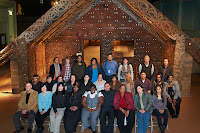
- One of the true accomplishments of the Energy Action Network was the collaboration and camaraderie that it nurtured among network members. All members were CEDA (Community and Economic Development Association of Cook County) intake sites: they provided services to residents in their communities and were paid set amounts for each application they completed (for utility assistance, weatherization, etc). As a result, when EAN began, the members saw themselves as competitors. After a year of working together, though, they started seeing themselves as collaborators: calling each other for help, referring clients to each other's offices when, for example, one of them was closing early for a holiday, etc. This was the result of our efforts to help the members get to know and appreciate each other and see themselves and each other as agents of creativity and change. At an event that I hosted and facilitated at The Field Museum, we had a group discussion in the Marae House (below), historically used by the Maori of New Zealand for community building and conflict resolution. After the discussion, one of the members came up to me and said something along the lines of, "I want you to know--we did not used to like each other. And now, we are working together. And you did this; all of you did this."

Please share your thoughts:
What would it mean to define sustainability as collaboration, in addition to weatherization?
How can these big ideas steer us in more innovative--and impactful--directions?
What are your favorite "big ideas" about sustainability?
What are your favorite examples of "big idea" initiatives?
Signing off,
Jenny
Tuesday, December 11, 2012
Forging City-Community Partnerships for Climate Action: Moving from Communication to Engagement
As promised, here's my report on the ICLEI-Canada conference, written as a guest blog post for Climate Access. Read the report here or check it out on the Climate Access website.
Either way--please share your thoughts:
What do you think are the best ways for local government to work with communities on sustainability issues?
With the new Emanuel administration, there are different priorities. How does the new approach compare to the old?
------------------------------------------------------------------------------------------------------------------
Two weeks ago, I had the privilege of giving the keynote
presentation at ICLEI-Canada’s Livable Cities Forum,
held in Hamilton, Canada. ICLEI is a global organization that helps its
members—local governments—advance their sustainability work through tools,
training, and networking. My talk, titled “What
Do Daycare and Soul Food Have to Do with Climate Change? Forging City-Community
Partnerships for Climate Action,” set the stage for the conference theme,
which focused on how local governments can engage non-traditional stakeholders
in climate work.

Drawing on my experience in Chicago engaging culturally and
socioeconomically diverse communities in climate action, it emphasized the importance
of empowering communities to take joint ownership of climate action. I
concluded with a countdown of the Top 10 Strategies for doing this:
10. Work through
trusted and umbrella organizations
9. Establish a
Climate Action Leaders Network
8.
Focus on collective solutions
7.
Build on assets
6. Identify and
publicly recognize local champions and innovations
5. Incorporate
climate action into existing programs
4. Link climate
metrics to quality of life indicators
3. Create
neighborhood demonstration hubs
2. Make it (hyper-)
local, cultural, & personal
1. Create & use
place-based, visual, & participatory tools
Over the next two days, I was inspired by the case studies I
heard about how local governments across Canada are reaching out to their
constituents. I came away from the conference wanting to revise and expand my
original list, to more deeply incorporate these ideas:
Focus
on relationship- and community-building
The Toronto and Region Conservation
Authority presented its SNAP
program--Sustainable Neighborhood Retrofit Action Plans—which aims to
inspire community members to “reclaim responsibility to care for their
neighborhoods.” Its projects are tailored to community assets. For example, in
one community with rich cultural diversity, a history of social activism, and
lots of gardens, SNAP focuses on food. In another community where people care
deeply about their yards, it focuses on native landscaping. The overall goal is
to strengthen relationships, among people and between people and nature, and to
facilitate engagement by nurturing “a sense of belonging to a neighborhood
invested in its future.”
Institute
collaborative problem-solving structures
Toronto’s Public Health agency shared
its approach to creating Canada’s first Shade
Policy and Guidelines, through the Toronto Cancer Prevention Coalition,
which included members from a broad array of fields in and outside of
government. Relationship-building takes time; and it took 10 years to create
the shade policy. But after being rejected once by the City Council, it now has
broad support from multiple sectors, including urban foresters, the school
board, public health, universities, and the parks department. Key to building
support, presenters said, was the multidisciplinary nature of the coalition; identifying
co-benefits; linking to existing policy frameworks (beyond health, where this
project started, to environment, for example, the Urban Heat Island Directive);
supporting community champions; and demonstrating the project concept through
pilot projects.
Evergreen CityWorks, whose mission
is to green cities, also focuses on collaborative problem-solving, which is the
second of a three-step behavior change model that starts with doing research to
identify a problem and ends with implementing innovation projects. The
problem-solving step involves bringing diverse stakeholders together for
activities such as scenario planning, charrettes, and data visualization.
Make
climate change and climate action local and visual
Our host, the City of Hamilton,
highlighted their Hamilton Climate
Change Action Charter, which organizations and individuals can both sign on
to. As signatories, they commit to taking and reporting on climate actions in
their work or personal lives. According to coordinator Brian Montgomery, the
goal is not to get them to do new things, but rather to understand what they
are already doing that is in fact climate action—and thus see themselves in a
new light, as climate champions. Basically, the City is building a
constituency; and when they embark on the task of writing a climate action
plan, they will already understand what the community cares about and have broad
support.
The Hamilton Conservation Authority
is also focused on making climate change local and has produced a series of
short videos called Climate Change
in Our Own Backyard that show the local impacts of climate change on
traditions such as ice fishing. According to the presenter, residents did not
connect extreme weather events to climate change in the past—and these videos,
more than anything else the Authority has done, are making people want to get
involved in climate action.
Finally, Stephen Sheppard, of the University of British Columbia’s
Collaborative for Advanced Landscape Planning (CALP), presented examples of
visual tools that local government can use with communities to do collaborative
planning. For example, one data visualization tool is a moving graph paired
with a visual of a local landscape that shows how changes in sea level rise
will correlate directly with inundation of the landscape. In production now is
a place-based
video game on sea rise in the Delta community where the player takes on the
role of mayor and makes different choices and then sees the consequences. Dr.
Sheppard’s new book, Visualizing
Climate Change, also provides many examples of how visual tools can help
communities look to their present and past ways of life for low-tech solutions
embedded in local cultures.
Overall, these and other stories highlight the ways in which
community engagement—beyond communication, framing, and messaging—can help
broaden the climate action movement to include diverse stakeholders who have
not had a significant voice in our conversations or initiatives to date. The
Livable Cities Forum advanced this crucial conversation, and I hope we can
continue to expand on the lessons from this conference through online forums
like Climate Access and at conferences not only in Canada, but also in the U.S.
and beyond. What will this conversation sound like when we truly open it up? What
will climate action look like once it’s out of our hands?
Saturday, December 8, 2012
“Cierrale!” Building on Latino Values and Traditions to Fight Climate Change – and Strengthen Chicago’s Neighborhoods in the Process
I have written a number of articles about my community-based climate action work in Chicago, and will slowly share them here. Here's the first, prompted by a phone call that I received from Brenda Torres, who works with a New York City group called El Puente that is starting to engage Puerto Rican residents in Chicago, New York City, Puerto Rico, and Orlando, Florida around climate change. They are starting with "encuentros," or conversations, that bring together scientists and community leaders who have not yet been very involved in this issue. Their goal is to mobilize them to vote around this issue, starting with the next election.

Brenda got in touch with me because she found an article that I wrote about engaging Latinos in climate change work, for Toolkit partner Casa Michoacan's Mexican federation magazine this past summer, when they hosted a big gathering of federations in Chicago. That article is shared below.
Please share:
How have you worked with the Latino community, in Chicago or other places?
What's your experience of how different Latino practices and values connect with sustainability and climate action?
How are these practices and values similar to or different from those you have found in other cultural communities?
How are they different among different Latino populations?
Best,
Jenny


Brenda got in touch with me because she found an article that I wrote about engaging Latinos in climate change work, for Toolkit partner Casa Michoacan's Mexican federation magazine this past summer, when they hosted a big gathering of federations in Chicago. That article is shared below.
Please share:
How have you worked with the Latino community, in Chicago or other places?
What's your experience of how different Latino practices and values connect with sustainability and climate action?
How are these practices and values similar to or different from those you have found in other cultural communities?
How are they different among different Latino populations?
Best,
Jenny
“Cierrale!” Building on Latino Values and
Traditions to Fight Climate Change – and Strengthen Chicago’s Neighborhoods in
the Process
Over the past five years, Chicago
has gained international attention for its efforts to address climate change,
as laid out in the Chicago Climate Action Plan, released by the City of Chicago
in fall 2008. In particular, Chicago has been recognized for involving a broad
swath of stakeholder groups in the Plan’s implementation. In May 2012, Chicago
was one of three cities awarded the prestigious Siemens Sustainable Community
Award for its “multi-disciplinary
approach to sustainability” bringing together “businesses, advocacy groups,
philanthropists, utilities, government offices, museums, and restaurants.”
What is climate change?
Climate change refers
to shifts in weather patterns over long periods of time. It has the greatest impact on those lacking the resources to adapt. Learn more at: climatechicago.fieldmuseum.org/learn.
Chicago’s
multidisciplinary approach is succeeding in large part because it links climate
action to improving quality of life. Diverse groups across the city are getting
on board because they see that particular climate actions—like installing rain
barrels or native plant gardens or weatherizing homes—will also positively
impact other issues residents care about, like flooding, health, and saving
money.
Latino
organizations are playing a key role in Chicago’s climate action efforts.
They are
mobilizing their communities to address the strategies of both the Chicago
Climate Action Plan and the area’s other major plan, the Chicago Wilderness
Climate Action Plan for Nature. And they are strengthening community life in
the process.

For example:
- The Pilsen Environmental Rights and Reform Organization (PERRO) helped lead the successful fight to close down the Fisk and Crawford coal-fired power plants, a major source of pollution and carbon emissions in the Latino neighborhoods of Pilsen and Little Village since the early 1900s.
- Other organizations in Pilsen are installing and running gardens, to grow food, provide more green space for play and socializing, improve health, and store carbon. Michoacán. They serve as a cultural symbol and as a powerful symbol of the ability to freely cross borders. The most recent garden installed in the neighborhood is the Mary Zepeda Native Garden, a collaboration between Casa Michoacán, The Field Museum, PERRO, and the daycare center El Hogar del Niño. It serves as a play space for the daycare and an outdoor learning classroom for the community.
- Latino organizations comprise 15% of the Energy Action Network, a city program that provides funding to community organizations across the city to sign up residents for home weatherization and engage them in energy conservation, to save money, reduce carbon emissions, and improve health.
- On the Southwest Side, the Academy for Global Citizenship charter school draws on their Latino families’ traditions of reuse and outdoor socializing to bring them together for a variety of climate action-related activities including a very popular community-wide rummage sale.
- The Little Village Environmental Justice Organization (LVEJO) participates in national and international climate justice efforts and leads local environmental justice campaigns that also link to climate action, including public transit, water, clean power, and open space.
- Chicago’s Latino residents have a proud history of entrepreneurship, and a number of small businesses are incorporating climate action into their business models. For example:
o In 2007, a group of Pilsen immigrants laid off from
their jobs founded Workers United for Eco Maintenance, which uses only green cleaning
supplies.
o An entrepreneur in
Pilsen collaborated with a local baker to create a Chalupita, an edible dough bowl for the ice cream he sells, precisely
to eliminate waste.
o In South Chicago,
entrepreneurs have been engaging in climate action for a long time—without
thinking of their work as climate action. The junqueros are homegrown recyclers, collecting cast off metal items and
selling them to reclamation centers. This practice is complemented by repair
shops owned by Mexican community members that fix small electronic appliances
that would otherwise find their way into landfills.

An entrepreneur in
Pilsen created an edible bowl to eliminate waste
Latino heritage provides key building
blocks for local climate action.
The
effort described above to turn Pilsen into a Monarch sanctuary provides one
example of a growing trend in Chicago: engaging immigrant and other ethnic
communities in environmental and climate action by drawing on their environmentally-friendly
strengths, including cultural values, traditions, and practices. This trend is
being led in large part by The Field Museum and by the Chicago Cultural
Alliance, a collaboration of over 25 community museums and cultural centers—including
Casa Michoacán—that draws on cultural heritage to effect
social change.
Many
of these strengths have been documented through rapid research studies
conducted by Field Museum anthropologists between 2008 and 2012 in nine
communities across Chicago, including in the predominantly Mexican community of
Pilsen and in two other areas with large Latino populations, South Chicago and
the Southwest Side.
These
studies reveal a strong environmental consciousness among Latinos, particularly
Mexicans and Mexican-Americans, developed partly through familiarity or
personal experience with water scarcity and droughts in Mexico. Residents told
the anthropologists different stories related to this issue. One
woman said that in Monterrey you can only use your hose on certain days, and people
are careful not to leave water running. Another Pilsen resident recalled the “Cierrale!” water conservation campaign
from the 1970s, which he claimed became a household phrase, like “Got milk?” Another
resident from South Chicago reported a popular phrase in a rural Mexican
village where she worked: “Gota a gota se
agota el agua.”

Water conservation
campaign in Mexico
A number of residents who grew up in rural
areas developed close connections with nature and the land—connections that
they miss in Chicago. One man in
Pilsen reminisced about his mother and aunts in Mexico grinding fresh corn
using a mano and metate and recalled one year in which his family persisted almost
entirely on food that they grew. Some residents try to recreate these
connections and pass them down to their children through gardening. A
young staff person at Pilsen’s Orozco School said that neighborhood parents
have been very supportive of the community garden and spend time with their
children talking about gardening practices from their childhoods. Another
Pilsen family reported keeping chickens in their Chicago garage and collecting
fresh eggs every morning with their children.
Residents also spoke about changes
in weather patterns and the negative impacts on Mexico of recent extreme
weather events—a key marker of climate change. One South Chicago resident from
Cuernavaca said that it always used to feel like spring, but now her friends
and family are buying winter coats. A community organizer in Pilsen made a
direct link to climate change, explaining that it exacerbates migration.
Referring to a recent hurricane and subsequent flooding in Mexico, he said that
lack of development combined with environmental disasters like earthquakes, mudslides,
and volcanoes will keep pushing Mexicans to migrate to Chicago.
Think
global, act local.
One
of the key findings of The Field Museum’s research, across all of the research
communities, is that many Chicagoans care about climate change—but don’t know
what it has to do with Chicago or their lives and don’t know what they can do
to make a difference. The research findings from the studies in communities
with strong Latino populations suggest that cultural values, traditions, and
practices provide a strong platform for making climate change personal. For
this reason, they provide a platform for engaging residents in climate action
programs, such as water and energy conservation, green design, climate-friendly
gardening, and waste reduction.
The
findings also demonstrate the value that a transnational perspective brings to
understanding and motivating peole to act on climate change. The studies of
Latino and other immigrant communities—West Ridge (South Asian) and the far
northwest side (Polish)—all suggest that immigrant families may possess a
particular global awareness of climate change that makes the issue feel
personal even if they haven’t yet seen its impact on the Chicago region. Among
the Polish and Polish-American research participants on the northwest side, for
example, many people have been involved over the past decade in helping family,
friends, and communities in Poland deal with severe flooding.
This
transnational perspective can lead to important transnational action programs
and campaigns. For example, in the Polish community, the Polish American Chamber
of Commerce is planning to take a delegation of Polish contractors from Chicago
to Poland to learn about the Polish green building industry. In 2011, another
organization in Chicago, the Council of Islamic Organizations, organized the “Green Ramadan” campaign to
promote green living and climate action among Chicago region Muslims as part of
a long–term solution to social disasters in Africa, including drought and
famine in Somalia.
These
transnational understandings and campaigns are key because they make climate
change a personal issue without making it an insular one. We live in a global
world—and Chicago’s immigrant communities are pointing the way for global-local
climate solutions that build on our collective knowledge and rich,
interconnected lives.
Learn
more
The Chicago Community Climate Action Toolkit
presents over 60 multimedia tools to help communities develop and carry out
local climate action projects that build on community strengths and improve
quality of life. It was created based on The Field Museum’s research studies,
in collaboration with four of the research communities, including Pilsen, and
over 40 partners from throughout Chicago. The Mary Zepeda Native Garden was
installed as part of the Toolkit project. Watch a video documentary about the
garden and download other tools at: climatechicago.fieldmuseum.org. Materials are available in English and
Spanish.

Subscribe to:
Posts (Atom)